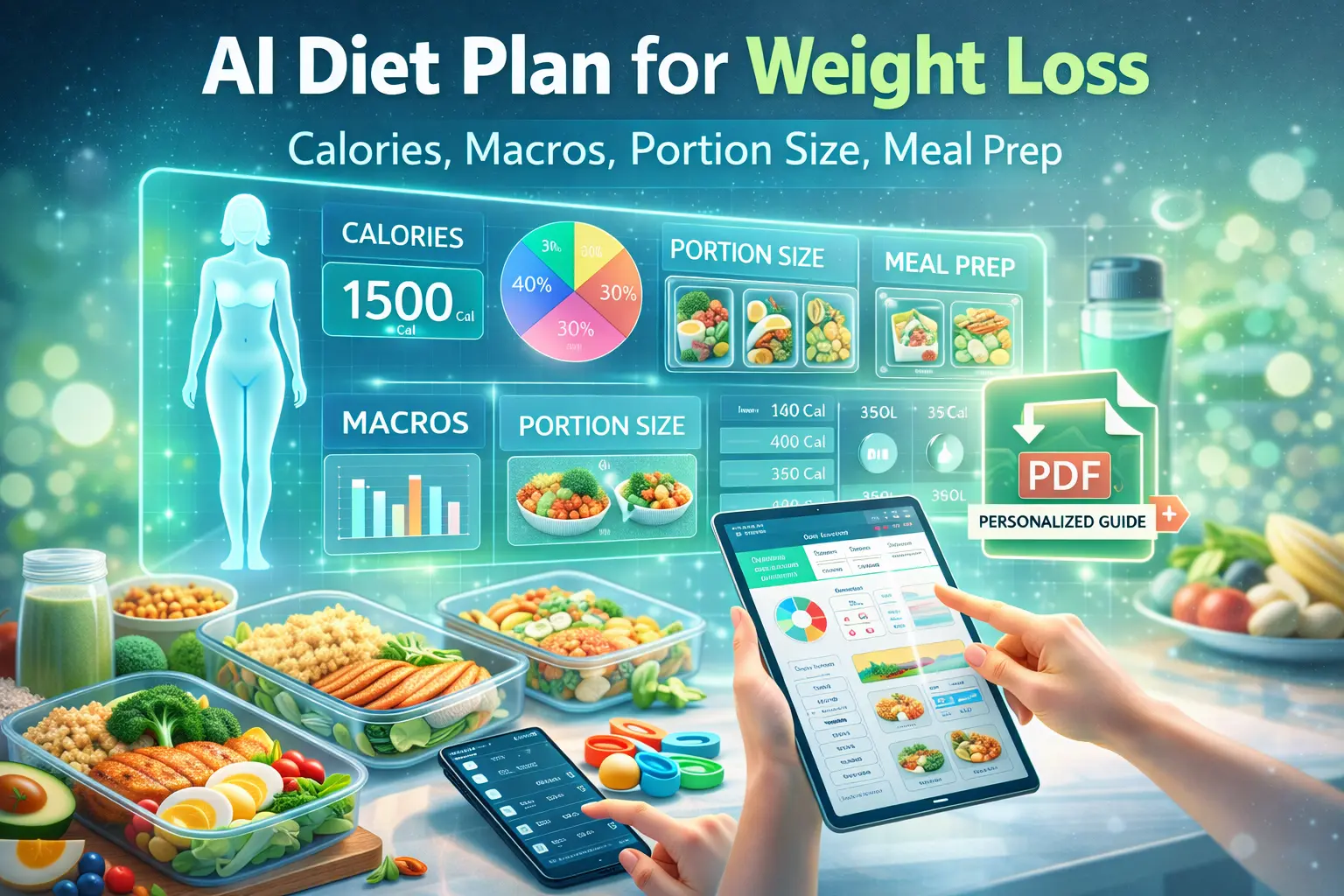
Discover how an AI diet plan for weight loss can create a personalized calorie target, macro split, portion sizes, meal prep guidance, and a printable PDF meal plan for better results.
AI Diet Plan for Weight Loss: Calories, Macros, Portion Size, Meal Prep and PDF with Full Personalized Guide
Weight loss becomes much easier when the plan feels personal, practical, and simple enough to follow every day. That is exactly why an AI diet plan for weight loss is becoming such a powerful idea. Instead of following a random chart copied from the internet, a person can fill out a short form and receive a meal plan that matches their body, routine, food preference, and fat loss goal.
A good weight loss plan is not about eating less and feeling miserable. It is about eating smart, staying consistent, and building a structure that the body can actually live with. The best plans balance calories, protein, carbs, healthy fats, portion control, meal timing, and meal prep in a way that does not feel overwhelming. NIDDK says the key to losing weight is choosing a healthy eating plan you can maintain over time, and being physically active helps you use more calories and maintain weight loss.
This is where AI can make the journey simpler. A personalized diet plan can take a person’s age, height, weight, activity level, work schedule, food likes and dislikes, and health concerns, then turn that information into a clear daily eating guide. The result is not just a diet chart. It is a full fat loss roadmap.
Why an AI Diet Plan for Weight Loss Works Better Than a Random Diet Chart
Most people do not fail because they lack motivation. They fail because the plan does not fit their life. A strict chart may look good for a few days, but if it ignores appetite, routine, hunger, family meals, office timing, cravings, or budget, it becomes impossible to keep following. A personalized AI diet plan works better because it is built around the real user, not a theoretical average person.
Weight loss is driven by energy balance. Calories are the energy in food and drink, and if the calories a person eats and drinks are more than the calories the body uses, weight can increase. If the body uses more energy than it receives, weight can decrease. NHS explains that calories are a measure of energy and that body weight changes when intake and use are not the same.
That is why a smart AI diet plan focuses on more than “healthy food.” It focuses on the right amount of food, the right timing, the right balance of nutrients, and the right meal structure. A plan that helps with fat loss should still be satisfying, realistic, and stable enough to continue for weeks and months.
How Calories Shape a Weight Loss Plan
Calories are the foundation of every weight loss plan. If a person wants to lose fat, the plan must help create a calorie deficit in a controlled and sustainable way. That does not mean starvation. It means eating fewer calories than the body burns, while still covering nutritional needs.
Calories are usually written as kcal on food labels. That is important because people often see the word “calorie” and assume it means only diet or fat loss. In reality, calories are just a measurement of energy. NHS states that energy in food or drink is measured in calories, and food packaging often labels this as kcal.
A good AI diet plan can calculate a calorie target based on the user’s profile and then divide that target across the day. For example, if a person needs 1500 kcal for a weight loss phase, the plan may split that into breakfast, lunch, snacks, and dinner in a way that prevents extreme hunger. The goal is not to force the user into a tiny food box. The goal is to create a daily calorie range that still feels normal.
Many people also underestimate how useful calorie awareness can be. Once someone understands the energy value of meals, it becomes easier to make better choices without constant guesswork. A meal with a lot of oil, sugar, and refined carbs can be much more calorie-dense than it looks. A meal with protein, fiber, and water-rich vegetables can feel larger while still fitting the target better.
Why Macros Matter in an AI Weight Loss Plan
Calories matter, but macros matter too. Macros, or macronutrients, are the big nutrient categories in food: protein, carbohydrates, and fats. A well-designed AI diet plan for weight loss can balance these so the person feels full, recovers better, and stays energized.
Protein helps support fullness and muscle maintenance during weight loss. Carbohydrates provide energy, especially when they come from higher-fiber foods. Healthy fats support hormones, absorption of nutrients, and meal satisfaction. When these are balanced well, the plan becomes much easier to follow.
A smart AI diet plan can create a macro split based on the user’s goal and activity level. A more active person may need more carbohydrates around workouts. A person who gets hungry very fast may benefit from a higher protein breakfast. Someone with a sitting job may need smaller carb portions and more fiber-rich meals. The AI can use the user’s form data to adjust these details.
The most important thing is not to make macros complicated. People often give up because they think they need advanced nutrition knowledge to lose weight. They do not. They need a simple structure that tells them how to build a plate. The AI should make macros feel useful, not intimidating.
A Simple Macro Framework for Weight Loss
There is no single perfect macro ratio for every person. That is why the best AI plan should use personalization rather than one fixed formula. Still, a practical starting framework can help. A weight loss meal plan often works well when meals include a solid protein source, a controlled amount of carbohydrate, and a moderate amount of healthy fat.
Fill the form below and start your healthy journey today.
[smart_form id=”form_yp4l1x”]
For example, breakfast may be built around eggs, curd, paneer, tofu, Greek-style yogurt, dal chilla, or oats with protein support. Lunch may include roti or rice in a measured amount, a lean protein source, vegetables, and a small amount of fat. Snack time may include fruit, nuts, seeds, or a protein-based option. Dinner may be lighter but still balanced.
This kind of structure helps the body get enough nutrition while staying within calorie goals. It also reduces the “I am dieting so I am always hungry” feeling. A good AI diet plan should never feel like punishment. It should feel like a smart system.
Portion Size Is Where Most Diets Succeed or Fail
Portion size is one of the most important parts of weight loss, yet it is often ignored. Many people know what healthy food is, but they do not know how much of it to eat. NIDDK explains that a portion is how much food you choose to eat at one time, while a serving is the amount listed on a food label. That difference matters a lot for weight management.
A person can eat healthy foods and still overeat. A handful of nuts, a “small” bowl of rice, extra oil in cooking, large serving spoons, and repeated snacking can quietly push calories higher than expected. That is why a good AI diet plan should include portion guidance, not just food names.
Portion guidance makes the plan practical. Instead of saying “eat dal,” the plan should say “one bowl dal.” Instead of saying “eat rice,” it should say “half to one cup cooked rice depending on the goal.” Instead of saying “have nuts,” it should say “a small handful.” These small details improve compliance and reduce confusion.
For weight loss, portion control is especially helpful because people do not need to eliminate favorite foods completely. They need a better way to fit those foods into the day. That is a much more sustainable strategy than extreme restriction. NIDDK and other health sources emphasize healthy eating plans that can be maintained over time rather than short-term punishment diets.
How an AI Plan Can Manage Portions Automatically
One of the biggest advantages of AI is that it can adjust portions for the user automatically. The system can use the person’s height, weight, age, activity level, and goal to create portion sizes that make sense. It can also adapt to different food cultures, which is very important for Indian users.
For example, the same person may need a different breakfast portion on a rest day versus a workout day. The same lunch portion may feel too big for one user and too small for another. Some users are comfortable eating three big meals. Others do better with four or five smaller meals. AI can turn that into a personalized plan.
The plan can also help with plate building. Half the plate can be vegetables or salad, one quarter protein, and one quarter carbohydrate, with fat added in a controlled way. This kind of visual planning helps users avoid accidental overeating without needing to count every single bite. For people who dislike weighing food, this is a huge benefit.
Meal Prep Makes Weight Loss Easier
Meal prep is one of the most practical tools for weight loss. Even the best diet plan can fail if the user has nothing ready when hunger hits. A well-prepared kitchen removes decision fatigue and keeps the user from ordering random food, skipping meals, or overeating later.
Meal prep does not have to mean cooking all food for an entire week in one day. It can be simple. It can mean washing vegetables in advance, boiling grains or lentils, marinating protein, making chutneys or dips, or portioning snack boxes. A good AI plan can suggest meal prep steps that match the user’s real schedule.
For example, a person with a busy office routine may need overnight oats, pre-cut salad ingredients, pre-portioned nuts, and ready-to-eat protein options. A person who cooks daily may just need a shopping list and a few batch-cooking tips. AI can keep the meal prep suggestions light or detailed depending on the user’s preference.
This is important because many people think weight loss is mostly about willpower. In reality, it is often about environment. When good food is ready and unhealthy food is not as easy to grab, the user naturally makes better choices. The plan becomes easier to follow because the kitchen supports it.
What a Good Weight Loss Meal Prep Guide Should Include
A meal prep guide should be simple enough to use and detailed enough to be useful. It can include which ingredients to buy, how to store them, what to cook first, and how to portion meals for the next day or two. It can also include basic cooking methods that keep calories in control, such as grilling, roasting, steaming, boiling, or sautéing with limited oil.
The meal prep guide should help users make repeatable food combinations. Repetition is not boring when the food is good and the user is getting results. A person does not need 50 new recipes each week. They need a set of reliable meals they can rotate without thinking too much.
The best meal prep system also respects the user’s energy. On a busy day, the user should not have to plan from scratch. They should simply open the plan and follow it. That is why an AI-generated diet plan with prep guidance is much better than a random blog post of food ideas.
A Personalized Weight Loss Plan Should Change with the User
Weight loss is not a straight line. Some days are lower energy days, some days are more active, and some weeks are more stressful than others. A good AI plan should be flexible enough to adapt.
If the user starts losing too fast, the plan may need more food. If the user is not losing at all, portions may need adjustment. If hunger is too high, the plan may need more protein or fiber. If the user is missing workouts, the meal timing may need to be different. A personalized system can handle these updates much better than a fixed paper chart.
This flexibility matters because real life changes. People travel, attend family events, work late, get sick, or experience stress. A diet plan that can adapt will last longer. And when a plan lasts longer, it has a better chance of helping the user actually reach the target.
What the User Should See in the AI Output
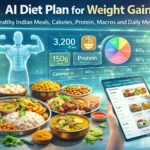
The AI output should feel complete and easy to use. A strong plan can include the daily calorie target, macro breakdown, suggested meal timing, portion sizes, meal ideas, snack ideas, cooking instructions, and a downloadable PDF. It can also include a grocery list so the user knows exactly what to buy.
A great output does not just say what to eat. It explains why the structure works. For example, the plan can show that breakfast includes protein to support fullness, lunch contains controlled carbs for energy, snacks stay light and useful, and dinner is balanced without being heavy. This kind of structure makes the user feel guided.
The plan should also feel readable. If it is too technical, users will ignore it. If it is too vague, users will not trust it. A clean AI plan strikes the balance between expert structure and simple language.
How to Build a Weight Loss Plan That People Actually Follow
The best diet plan is not the most aggressive one. It is the one the user can follow on a normal Tuesday. That means the food must be realistic, the portions must make sense, and the routine must match the user’s schedule.
A practical AI diet plan should take into account whether the user wakes up early or late, works a desk job or an active job, eats at home or outside, likes Indian food or mixed cuisine, and prefers vegetarian or non-vegetarian meals. It should also consider the user’s family meals, snack habits, and budget.
Consistency comes from convenience. If the plan is too complex, the user will abandon it. If it is simple and satisfying, the user will keep going. That is why personalization is such a powerful advantage in weight loss.
Example of a Simple AI Weight Loss Day
A practical weight loss day may look different for different people, but the structure usually follows the same logic. Breakfast should give energy and fullness. Lunch should be balanced. Snacks should prevent overeating later. Dinner should be satisfying but not excessive.
A sample day might include a protein-based breakfast, a fruit or nut snack, a lunch with controlled grains and vegetables, an afternoon snack that is not sugar-heavy, and a dinner that is lighter than lunch. The exact foods can change based on whether the user is vegetarian, non-vegetarian, or has a specific health condition.
The important part is not the exact menu. The important part is the pattern. A good AI plan can turn the pattern into a custom menu so the user does not have to guess every day.
Calories and Weight Loss Without Confusion
Many people overcomplicate calorie counting. But calories are simply energy from food and drink. That means calorie tracking is not about perfection; it is about awareness. NHS explains that calories are a measure of energy and are listed as kcal on packaging, while NIDDK says sustainable weight loss is best supported by a healthy eating plan and physical activity.
An AI plan can make calorie awareness much easier. The user does not need to calculate everything manually. They can see the estimated calories for each meal, the total for the day, and the approximate balance between meals. That creates clarity.
A clear calorie target also helps avoid the extremes. Too few calories can lead to fatigue, hunger, and eventual rebound eating. Too many calories can slow progress. A smart AI system finds the middle ground and keeps the user moving toward the goal.
Why Gradual Weight Loss Works Better
Fast weight loss looks exciting, but it usually does not last. CDC says people who lose weight at a gradual, steady pace, about 1 to 2 pounds a week, are more likely to keep it off than people who lose weight more quickly.
That is a critical message for any weight loss blog. Users should understand that healthy progress is usually gradual. A plan that promises dramatic results overnight is not realistic. A plan that supports steady progress is much more valuable.
This is where AI can play a positive role. It can set realistic expectations. It can keep the calories in a sensible range. It can encourage users to monitor progress without becoming obsessive. And it can help the user see that sustainable fat loss is a process, not a crash.
A Clean and Simple Strategy for Better Results
The most successful weight loss plans usually follow a few simple rules. Eat enough protein. Keep portions under control. Include vegetables. Limit liquid calories. Avoid constant snacking. Eat in a predictable pattern. Keep meals simple enough to repeat. Sleep well. Stay active. Manage stress as much as possible.
NIDDK notes that healthy foods and beverages, regular physical exercise, adequate sleep, and stress management may help support a weight that suits the person. CDC also notes that lifestyle with good nutrition, regular physical activity, stress management, and enough sleep supports a healthy weight.
A personalized AI plan should reflect these principles without sounding rigid. The user should feel supported, not judged. The plan should feel like a tool that makes life easier.
Who Should Use an AI Diet Plan for Weight Loss
This kind of plan is useful for beginners, busy professionals, students, people who have failed on many diets, people who need a structured routine, and people who want an easy way to understand calories, macros, and portions. It is also helpful for users who want a PDF they can save and follow offline.
It is especially useful for people who need to eat according to Indian food habits, because many global diet plans are not made for roti, dal, rice, sabzi, poha, idli, dosa, paneer, curd, and other daily foods. A good AI plan can adapt to local cuisine and still stay aligned with fat loss goals.
That makes the experience practical. The user does not need to change their entire life. They only need to improve how they structure their meals.
When to Adjust the Plan
An AI diet plan should not be static forever. It should be reviewed and adjusted when the user’s weight changes, activity changes, hunger changes, or routine changes. This is how personalization stays useful.
If the user loses some weight and the plan stops working, calories may need to be lowered a little or activity may need to increase. If energy gets too low, the plan may need more food quality or better meal timing. If hunger is too strong, the plan may need more protein, fiber, and meal balance.
That is why a great AI system should include a recalculation option. The plan should grow with the user instead of staying frozen at the original setup.
Why PDF Support Matters
A downloadable PDF is more than a convenience feature. It makes the plan easier to save, share, print, and revisit. Many users want to keep their meal plan on their phone, in a kitchen folder, or on the fridge. A PDF makes that easy.
A PDF also helps users follow the plan offline, which is useful in places where they do not want to open the app every day. It creates a sense of ownership and makes the plan feel more official and professional.
For a website or app, the PDF feature can make the experience much stronger because it gives the user a final takeaway, not just a temporary webpage.
Common Mistakes in Weight Loss Plans
Many plans fail because they are too strict. Others fail because they are too vague. Some fail because the user does not know what the portions mean. Some fail because they do not fit the user’s schedule. Some fail because they ignore hunger and cravings entirely.
Another common mistake is focusing only on food quality and ignoring quantity. Healthy food can still lead to weight gain if portions are too large. Another mistake is relying too much on liquid calories, packaged snacks, and random “diet” products that do not actually help. NIDDK’s portion guidance is useful here because it reminds users that how much they eat matters as much as what they eat.
A good AI diet plan avoids these mistakes by being simple, transparent, and realistic.
A Better User Journey from Form to Plan
The real power of the AI diet plan is the journey. The user fills out a form, the AI analyzes the information, and the user receives a structured weight loss plan with calories, macros, portions, meal prep guidance, and PDF support. That turns a confusing problem into a guided experience.
This is important because people do not just want information. They want action. They want something that tells them what to do next. A form-based personalized diet plan gives them exactly that.
The more accurate the form, the better the plan. The more clear the plan, the more likely the user is to follow it. And the more followable it is, the better the weight loss outcome can become.
Fill the form below and start your healthy journey today.
Frequently Asked Questions
What is an AI diet plan for weight loss?
It is a personalized meal plan created using user input such as age, weight, goal, food preference, and routine. The plan usually includes calories, macros, portion sizes, meal ideas, and practical guidance.
Why are calories important in weight loss?
Calories are a measurement of energy. Weight changes when the balance between calories eaten and calories used changes. NHS explains this clearly, and NIDDK emphasizes that a maintainable healthy eating plan is key for long-term weight loss.
What is the difference between a portion and a serving?
A portion is the amount of food a person chooses to eat. A serving is the standard amount listed on a nutrition label. NIDDK explains that understanding this difference is important for healthy weight management.
How fast should weight loss happen?
CDC says a gradual pace of about 1 to 2 pounds per week is more likely to be maintained than faster weight loss.
Can meal prep help with weight loss?
Yes. Meal prep reduces decision fatigue, supports consistency, and helps prevent random eating decisions that can push calories too high. This is a practical recommendation based on the need for a plan that can be maintained over time.
Should people with medical conditions start a weight loss plan carefully?
Yes. NHS weight loss guidance says people with a medical condition should consult a GP before starting a weight loss plan.
Final Thoughts
An AI diet plan for weight loss becomes truly useful when it goes beyond simple food lists and gives the user a complete system. Calories explain the energy target. Macros shape the balance of the day. Portion size keeps the plan realistic. Meal prep makes it easier to follow. PDF support makes it easy to keep and use.
That combination is powerful because it turns confusion into structure. It helps users stop guessing and start following a clear path. And when the path is personalized, it becomes much easier to stay consistent.
The best weight loss plans are not the harshest ones. They are the ones people can actually live with. A personalized AI diet plan can make that possible by giving each user a plan that feels built for them, not copied from a generic list. In the long run, that is what helps people build healthy habits and see real progress.